
transparency
In this article, we strive to answer these and other questions with complete transparency. It is of utmost importance to us that you gain a comprehensive insight into our production and material processes. We want to ensure that no one feels that information is being withheld or glossed over. If you feel that an important aspect is missing from this article, please do not hesitate to contact us at info@airpaq.de .
Table of contents
- Material sources and upcycling
- Origin of airbag materials, seat belts and seat belt buckles
- Upcycled car scrap quantities and their calculation
- Use of upcycled materials and the challenges involved
- Progress and environmental impacts in material use
- Prices and production
- Reason for the pricing of products
- Production in Romania
- Sustainability and fairness seal
- Upcycling Milestones
Where do our airbag materials and seat belts come from?
Our airbags and seat belts come from overproduction and rejects from renowned manufacturers of vehicle safety systems. These manufacturers primarily produce in Eastern Europe and supply leading automotive brands in Europe. We source a large portion of our materials from Romania, where our sewing and dyeing facilities are also located.
Airbags and seat belts are safety-critical components in vehicles. Therefore, even the smallest irregularities, such as a loose fiber, a textile defect, or an imperfect seam, mean they cannot be used and end up as waste. Some of these materials are recycled, while others are not. For the production of our backpacks, these "defects" are irrelevant, which is why we can efficiently reprocess this material.
Where do our seatbelt buckles come from?
In and around Cologne, we cooperate with various scrap yards. There, car recyclers collect seatbelt buckles from decommissioned vehicles. These are stored on pallets, and as soon as a profitable quantity has accumulated, we organize transport to our sewing factory in Romania. To keep our carbon footprint low, we always make sure to ship larger quantities in a single shipment.
Since the start of the Corona pandemic, the number of scrapped cars has decreased. In addition to procuring seatbelt buckles, we are therefore receiving more B-grade goods, blanks, and overproduction from manufacturers. These seatbelt buckles are often in like-new condition.
As a steadily growing company, we need to ensure our material procurement keeps pace. Unlike airbags and seatbelts, sourcing belt buckles is particularly challenging, as only specific models can be used with our backpacks. Therefore, we are very grateful for any help and/or contacts with manufacturers! If you have any suggestions, please contact us at info@airpaq.de .
Where do the upcycling claims regarding car scrap in our products come from?
Under each product in our shop, you'll find information on how much car scrap was upcycled through that purchase. For example, it's 1,024 grams for the roll-top backpack, 1,297 grams for the Biq, and so on. Using the roll-top backpack as an example, we'll show you how we calculate these figures:
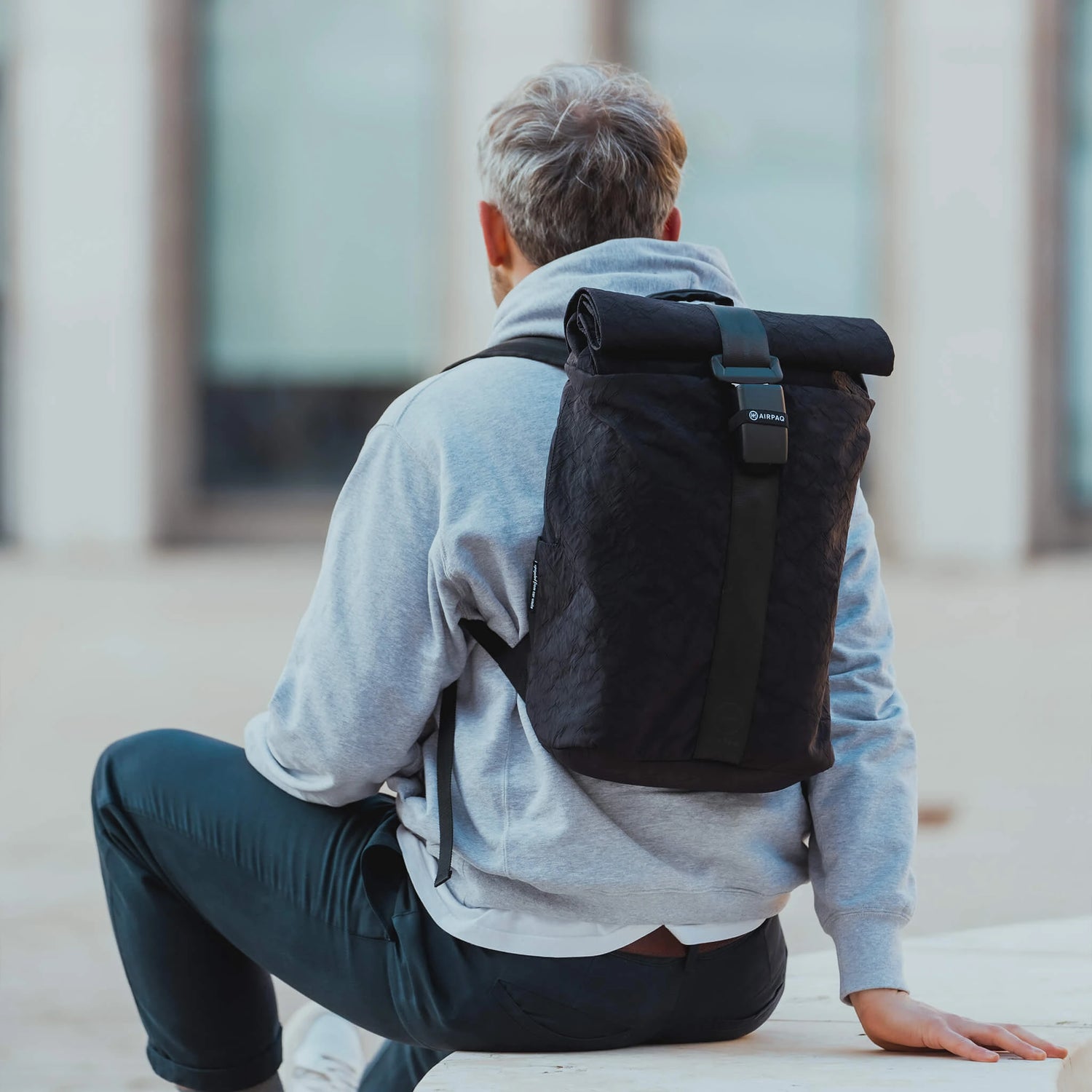
The following upcycled materials are needed to make a roll-top backpack:
- Material from approximately 2 airbags (used as roll-top, body, base and handle): approx. 469 g
- Approximately 3 seat straps (used for the back panel, the shoulder straps, the front area as protection for the zipper): approx. 505 g
- A strap buckle as a closure for the roll-top: approx. 100–150 g
This results in at least 1,024 g of car scrap , which, with a total backpack weight of approximately 1,200 g, corresponds to an upcycling content of around 85%.
Note: These specifications may vary slightly as we work with different materials.
Do we exclusively use upcycled materials?
No, because not all the components needed to make a backpack can be found in scrap cars. Furthermore, we want to produce a product that is as durable as possible, so we use new zippers, thread, padding, linings, and adjusters – for example, for the straps.
These components are crucial for everyday usability, practicality, and functionality. A backpack whose zipper breaks after a short time because it has already completed a product cycle is not sustainable in our view.
One of the biggest challenges in upcycling
A major challenge is the unpredictability of material sources. Understandably, producers try to minimize waste – a step forward for the environment, but a challenge for us.
This is also evident in deliveries from scrap yards, whose availability depends heavily on the number of cars being scrapped. While we, as a small company, were better able to compensate for fluctuations, this is becoming increasingly difficult with our growth – because our processes and jobs depend on constant availability.
While we receive plenty of airbags and seat belts, seat belt buckles are often incomplete or unusable. If, for example, the matching counterpart is missing, we occasionally have to purchase individual parts or entire buckles – this affects less than 10% of backpacks sold .
We avoid this as much as possible and are constantly on the lookout for additional suppliers and scrap yards. Besides our environmental commitment, economic viability also plays a role: New automotive components cost up to four times more than upcycled materials. Therefore, we only resort to new materials in emergencies – to ensure we meet our responsibility to the employees in the sewing workshop.
Despite these exceptions, the upcycling rate for affected backpacks is at least 70% . We want to steadily increase this rate – for example, we now also use airbag fabric as lining – and are constantly developing new solutions and material approaches for the future.
Do we use environmentally harmful materials?
Airbags are made entirely of polyamide (nylon), the production of which requires a high amount of embodied energy – including through the use of petroleum. Petroleum extraction pollutes the environment, soil, air, and water.
However, since we exclusively use rejected materials, we ensure that these resources are not wasted. By reusing them, we extend the material's lifespan – thus making the original resource consumption more sustainable.
The most critical point in our own value chain is the washing and dyeing process. Here we work with a dye works that has specialized in ecological standards for over 30 years:
- Modern dyeing machines with extremely low water consumption (e.g. only 5 liters for 50 kg of fabric instead of 300–400 liters for conventional machines)
- Use of exclusively Oeko-Tex certified dyes
- Own wastewater treatment plant for the reprocessing of wastewater
Why are our prices so high?
We frequently receive questions about our prices – and we want to be completely transparent here: Our goal is to produce a sustainable and fairly produced product – and not a luxury product for a few.
A large part of the costs arises from:
- Fair wages for seamstresses and local staff (above minimum wage, modern working conditions, air conditioning, break regulations, no overtime, EU standards)
- Handcrafted production ensures the highest quality.
- Costs for sourcing scrap cars (yes, even waste costs money – scrap dealers make their living from it)
Fair and sustainable production is more expensive than conventional production. We strive to remain competitive – and are convinced: our quality is worth the price.
Why do we produce in Romania?
Our production in Romania has ecological, personal, and economic reasons:
- Regional proximity: Our material suppliers and production facilities are located within a radius of 20 to 150 km. This saves CO₂.
- Family ties: Our sewing workshop was founded over 20 years ago by the family of our co-founder – we know all our employees personally.
- Textile know-how: While much has been outsourced in Germany, the expertise is still available in Romania.
- Fair wages and good quality: Production in Romania is cheaper than in Germany, but meets high EU standards. This ensures the product remains accessible.
- Proximity to the sales market: We didn't want to outsource overseas – transport routes, quality control and sustainability would be jeopardized.
Why don't we have seals of approval like "Green Button" or "Fairtrade"?
We are striving for recognized certifications – but so far there are no suitable certifications for upcycled products like ours. Many materials come from third-party suppliers (e.g., seatbelt buckles, rejects) whose processes we cannot fully control.
But what we do have:
- Cottontex sewing factory in Timișoara : ISO 9001, SA 8000, ISO 14001, Global Recycled Standard (GRS)
- Dye works “Intercolor” : Oeko-Tex certified dyes, compliance with the EU chemicals regulation REACH
- PETA-Approved Vegan: We completely abstain from animal products.
We'll keep at it – and hope for more certification options for upcycling in the future.
How much scrap car material have we upcycled since our founding?
As of July 2023, we have processed the following quantities:
- 208,000 seat belts
- 168,000 airbags
- 54,000 seatbelt buckles
In total, this equates to around 220 tons (as of 2024) of upcycled car scrap that we have transformed into backpacks and accessories.